

Table of Contents
My multimeter died a few weeks ago. Not from age — from rain, during a fieldwork session where I should have known better.
So I went shopping for a replacement, and within five minutes I had the same problem every beginner has: there are meters for $3 and meters for $300, and nothing on the box tells you which one you actually need.
This guide fixes that. No brand worship, no “buy the most expensive one to be safe.” Just a clear way to match the meter to the work you actually do.
Why a Multimeter Comes Before Everything Else
Electricity is invisible. You can’t see 12 volts sitting in a wire, and you can’t see a dead resistor just by looking at it.
A multimeter is how you see it. It measures voltage, current, and resistance, and tells you whether a component is alive or dead — instantly.
Think of it like a stethoscope for a doctor. A doctor doesn’t guess what’s wrong with a patient by staring at them. They listen. Engineers don’t guess what’s wrong with a circuit either — they measure it.
If you’re building anything with Arduino, IoT sensors, or basic wiring, this is tool number one. Before the breadboard. Before the soldering iron.
What a Good Multimeter Actually Needs
Strip away the marketing, and every multimeter — cheap or expensive — needs to nail five basics:
- DC voltage measurement — for batteries, sensors, microcontrollers, most hobby electronics
- AC voltage measurement — for mains power and household wiring
- Resistance measurement — for testing resistors, wires, and continuity
- Current measurement — for checking how much a circuit is actually drawing
- Continuity / diode test — the beeping test that tells you if a wire or fuse is broken
Everything past this — auto-ranging, True RMS, capacitance, temperature, non-contact voltage detection — is a convenience feature, not a requirement. It changes how comfortable the meter is to use, not whether it works.
The Three Tiers of Multimeters (And Who Each One Is For)
Multimeters split into three practical tiers. The price jump between them isn’t random — it’s mainly about accuracy, True RMS measurement, and safety rating.
1. Budget / Manual-Ranging Multimeters ($5–$25)
These are entry-level meters. You select the measurement range yourself using the dial, instead of the meter figuring it out automatically.
- Basic accuracy (fine for hobby work)
- Average-responding AC measurement, not True RMS
- No capacitance, no temperature, no non-contact detection
- Manual ranging — a small learning curve, not a dealbreaker
Best for: students, hobbyists, and anyone doing basic Arduino, IoT, or DIY electronics.
2. Mid-Range Auto-Ranging Multimeters ($30–$80)
Here the meter picks the range for you, and accuracy jumps noticeably. Some models in this tier include True RMS, which matters more than people expect (more on that below).
- Auto-ranging
- Often True RMS
- Adds capacitance and frequency measurement
- Better build quality and safety rating
Best for: serious hobbyists, freelance electronics work, and small workshops.
3. High-End / Professional Multimeters ($100+)
This tier is built for people whose job depends on the reading being right the first time.
- True RMS as standard, not an add-on
- High safety (CAT) ratings for industrial environments
- Built to survive drops, dust, and daily abuse
- Designed for accuracy under distorted electrical signals
Best for: professional electricians, industrial engineers, and anyone working on safety-critical systems.
True RMS: The One Spec That Actually Matters
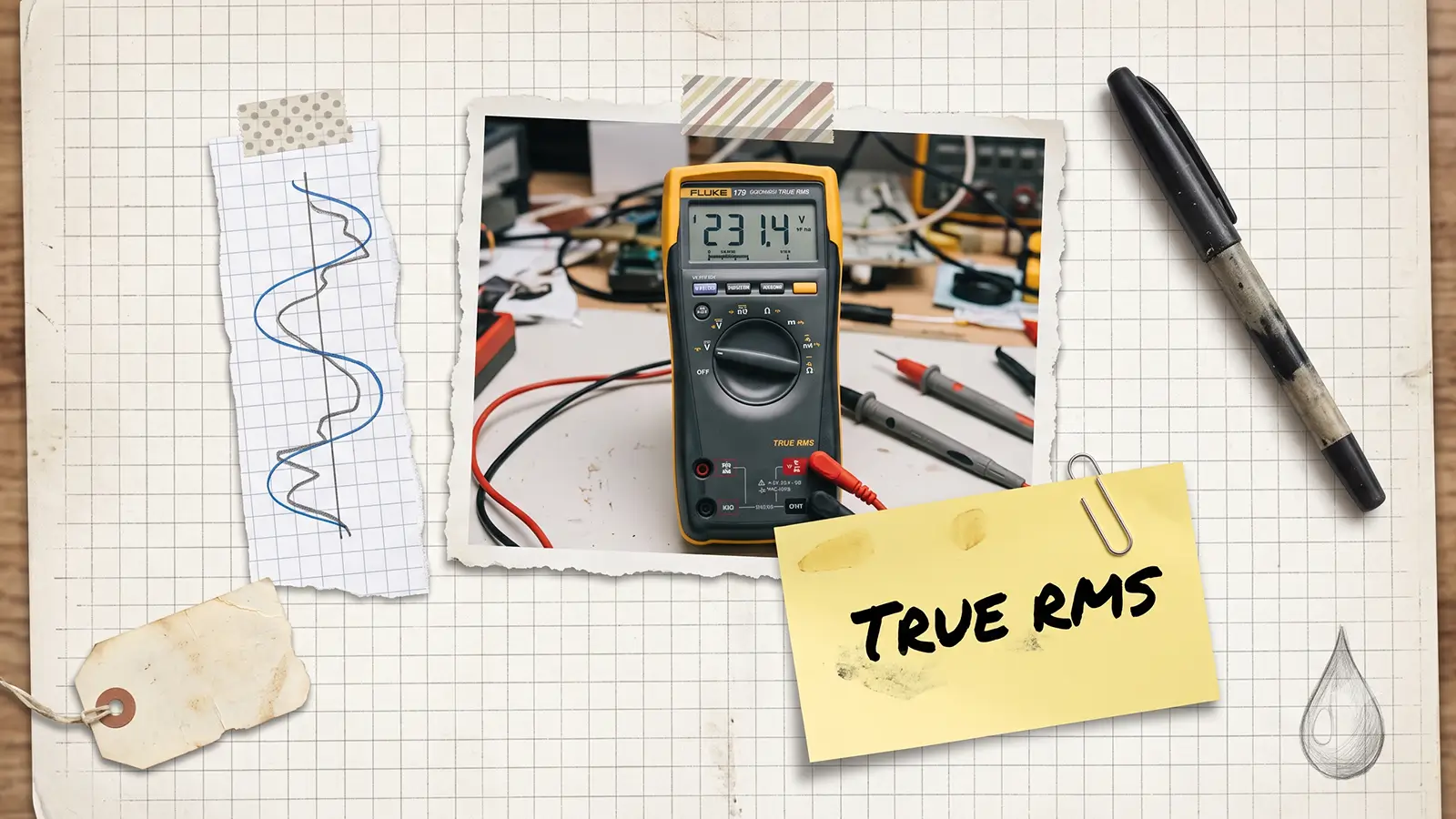
Here’s the thing most buyers skip past: True RMS (Root Mean Square) isn’t a luxury feature — it’s about whether your reading is even correct.
A regular (“average-responding”) meter reads clean, simple AC signals — like standard mains power — accurately.
But the moment you measure something with a distorted waveform — an inverter, a UPS, a motor driven by a VFD, a dimmer switch — an average-responding meter gives you a wrong number. Not slightly off. Actually wrong.
A True RMS meter reads the real value of that distorted signal correctly.
Simple rule: if your work only ever touches batteries, sensors, and standard mains, skip True RMS. If you touch motors, inverters, or industrial equipment, don’t.
Multimeters to Avoid
Not every cheap meter is a good budget meter. There’s a difference between “affordable” and “unsafe.”
Watch out for meters that:
- Have no safety (CAT) rating printed anywhere
- Feel flimsy or have loose battery covers
- Are priced dramatically lower than every other option in the same spec range
A multimeter priced far below its category isn’t a deal — it’s usually a meter with no overload protection, inconsistent readings, or a resistance function that fails after light use. You’re not saving money there. You’re gambling with either bad data or a small electrical shock.
Summary
A multimeter is the first real tool in any electronics toolkit, and picking the right one comes down to matching the meter to your actual work — not buying the most expensive option “to be safe.”
- Budget meters are genuinely enough for students and hobbyists.
- Mid-range meters earn their price with auto-ranging and often True RMS.
- High-end meters are a safety investment, not a luxury, once you’re working with motors or industrial systems.
Don’t overspend for specs you’ll never use. Don’t underspend on safety if your work demands it.
Responses